

There is poetry in ancient Arabian oases glistening with starry nights. An appeal of orange hues. A Bedouin vernacular. There is intrigue in a tree planted on a hill in the desert that fascinates the looker—in the branching, in the inclination with the wind. The desert calls the foreigner in.
Arabia’s Hijazi valley is a dramatic vastness of yellow where hills overlook otherworldly sandstone and granite landscapes. A road bends softly through the stony silence. Ribbons of asphalt press against the flanks of ancient rock. Sandstone walls rise on either side, tiered and weathered. The desert has spent millennia carving scripture into the canyon. The massifs stand like guardians of memory.
This is the palette of an enduring land; an orchestration of ochre plains and serrated ridgelines stretching toward a pale horizon. Palm groves gather in geometric clusters—in pockets of green—set against the immensity of rock and dust. Light settles on the cliffs in muted golds and rusted reds. The air is clear; its sparse shrubs anchored in a solemn dignity. At height, each grove looks impossibly small.
Such is Saudi Arabia’s AlUla: a desert that requires the passerby to witness its stillness and rugged grace, the subtle poetry embedded in its cliffs and canyons.
A story finds its voice as the land slows the viewer down. Observation is a kind of dialogue: the desert sharpens and amplifies the voices roaming within it. It speaks to the wanderer, and it leaves the wanderer wondering.
No human can pretend to understand what this patch of the Arabian desert holds: a poetic landscape that introduces a return to an austere experience where modern environments wear the colour of the land. In the desert, austerity is not exoticism but a language that safeguards a signal.
If writing is, at its core, a negotiation between the immaterial and the tangible, this desert is an invitation that echoes the ancient and the splendour of the sublime. A look ever ethereal: Madāʾin Sâleh has registered human presence since late antiquity; the living are in the presence of the dead. Thus, the invitation lingers while it challenges to imagine what narratives could emerge when the land itself becomes part of the dialogue.
To write, then, is to enter a contract with a land that does not hand metaphors—one that puts a spell on the writer before they have written a word. It is, therefore, up to the writer to understand its quiet certainty. This allure is a sine qua non of existence: it is called intent.
Wandering through Saudi Arabia is acknowledging that poetry speaks in the tongue of mystery. Under the sun, all distractions seem to evaporate like evanescent pillars of smoke. The earth commands reverence. Silence is articulate.
To walk through Dadān. To wander through Jabal Ikmah. To let the imagination ride on the wonders of Lihyanite and Dadanitic inscriptions set in millennia-old rock. Humans look small against the immensity of time, unable to cross this terrain unchanged.
The desert is a dream within a dream. Against the backdrop of a constant-connection lifestyle, it calls on discipline and the realisation that some landscapes author a story alongside its writer. It is written in the surrender of the wanderer, through which lies what the city-dweller forgets: the beauty in the world is not built for immediacy.
Sands were created not by the rushed erosion of rock, but by the persistent relentlessness of water flowing to meet land. Such are enduring narratives: a pathway inward. They exist beyond the need to impress.
Riding a camel to the store might be the right thing to do.
—R.
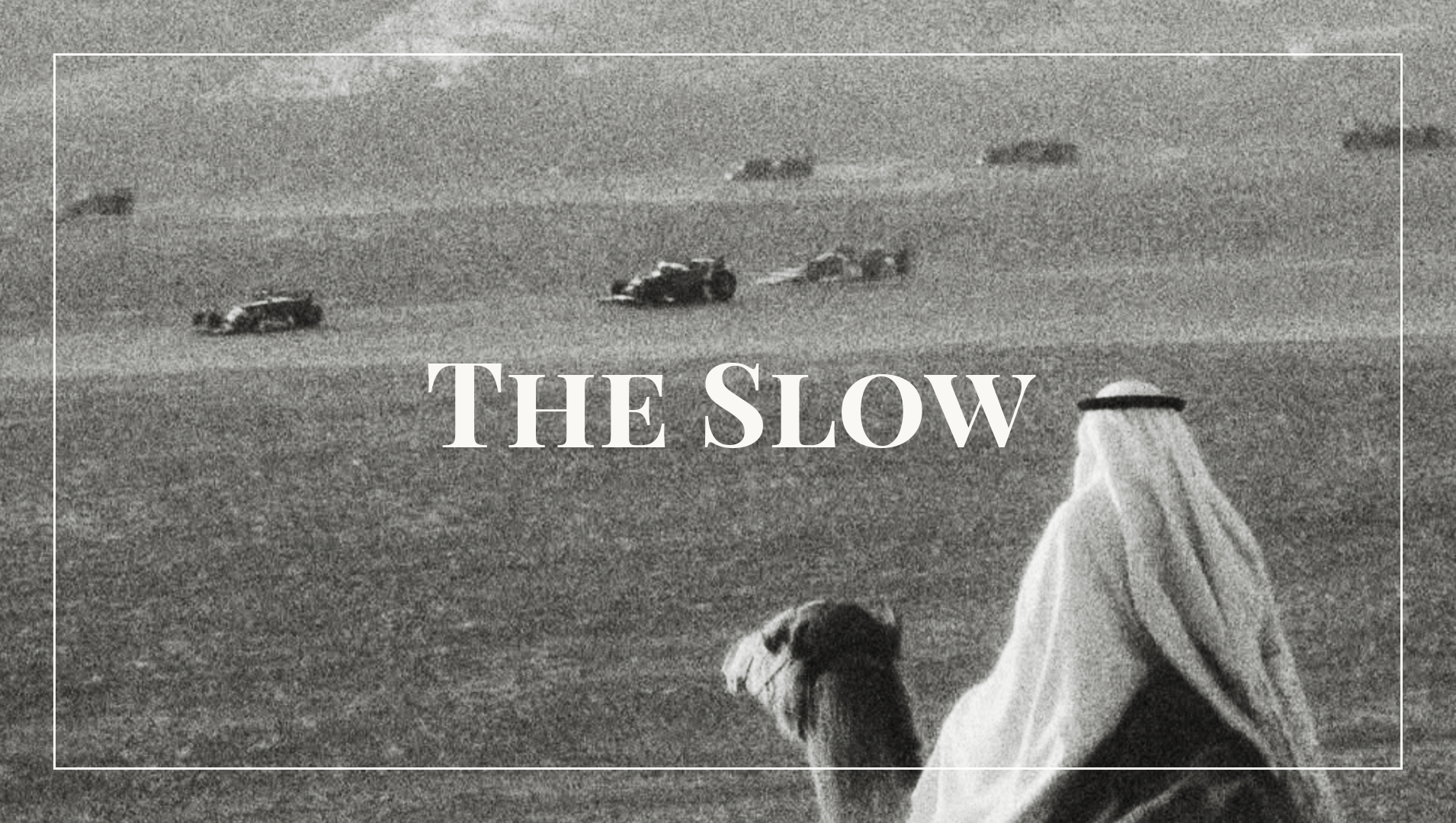
Featured image: Saudi man on his camel watching an F1 race in the desert — Composite, unattributed
