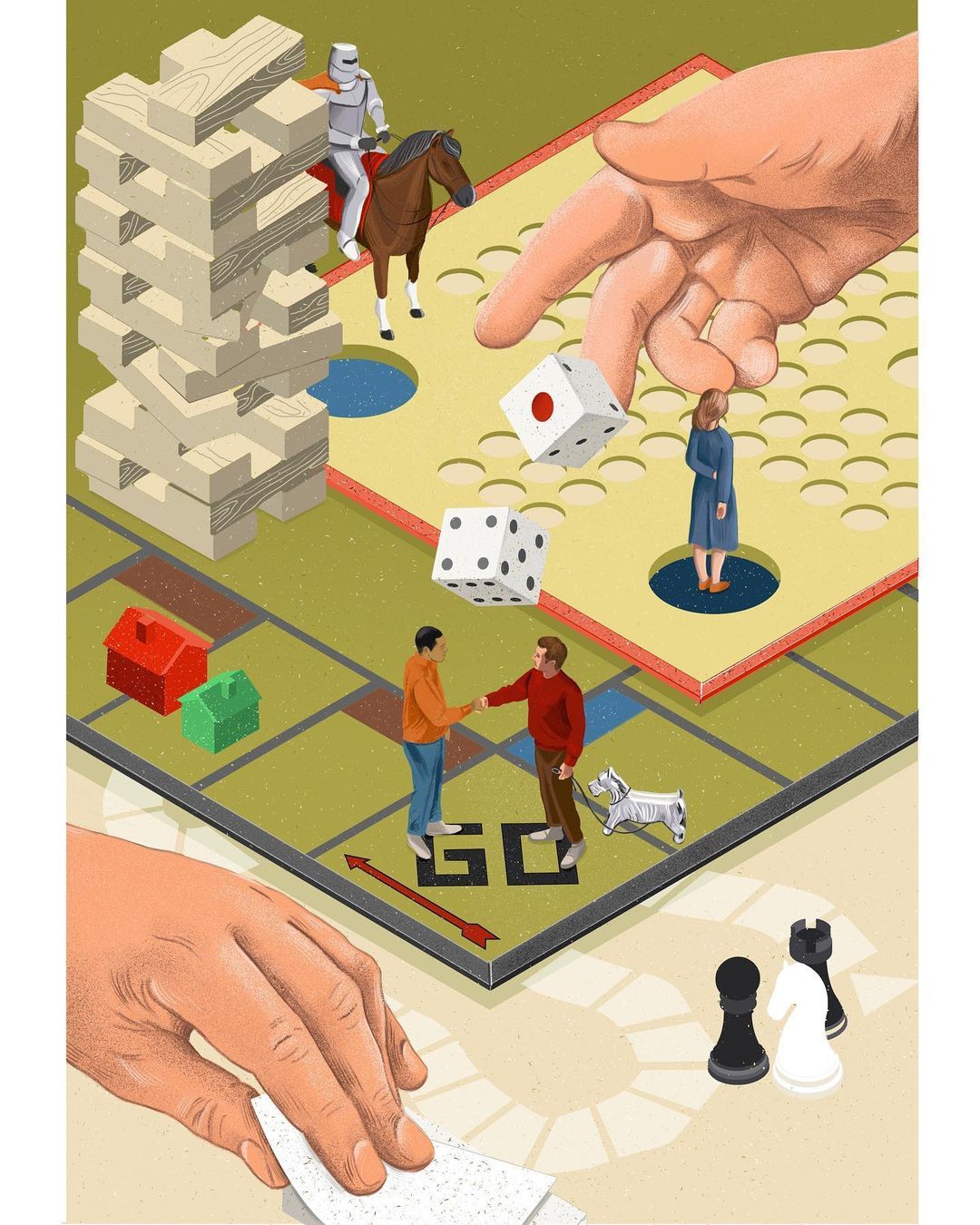
We adhere to the classical view that the game under consideration fully describes the real situation, i.e. any possibility of (pre)engagement, any repetitive aspect, any probability of error or any possibility of jointly observing a random event has already been modelled in a game tree. In principle, in situations where these restrictions are not respected, the game tree is simply used as an abbreviated notation for the rules of a much larger “extended game”, and it is the stability of the balances of the extended game that must be analysed.*
What we see and how we build the world affect our choices, reality, and the game.
When we reflect on the translation process, we tend to analyse things from a narrow angle: the segment we translate in the present moment. However, this “slice” of text is not accorded as much importance or significance as the big picture, which is the text, the final product, and which paradoxically already exists in the past in the form of a source text. The text extends beyond any restricted segment subject to translation, and which ultimately composes it.
It is, therefore, the stability of the entire textual component that is called into question.
—R.